东野圭吾推理系列
How technology boosts Beijing's air pollution governance_我的网站

A | “大热天的,能在这么冰凉的水里游泳,太舒服了!而且水还清得见底。

B | ”8月22日至23日,2026建德17℃新安江“夏日冬泳”轻极限运动挑战赛在建德火热举行,夺得游跑男子青年组冠军的上海选手王寅东兴奋地说。
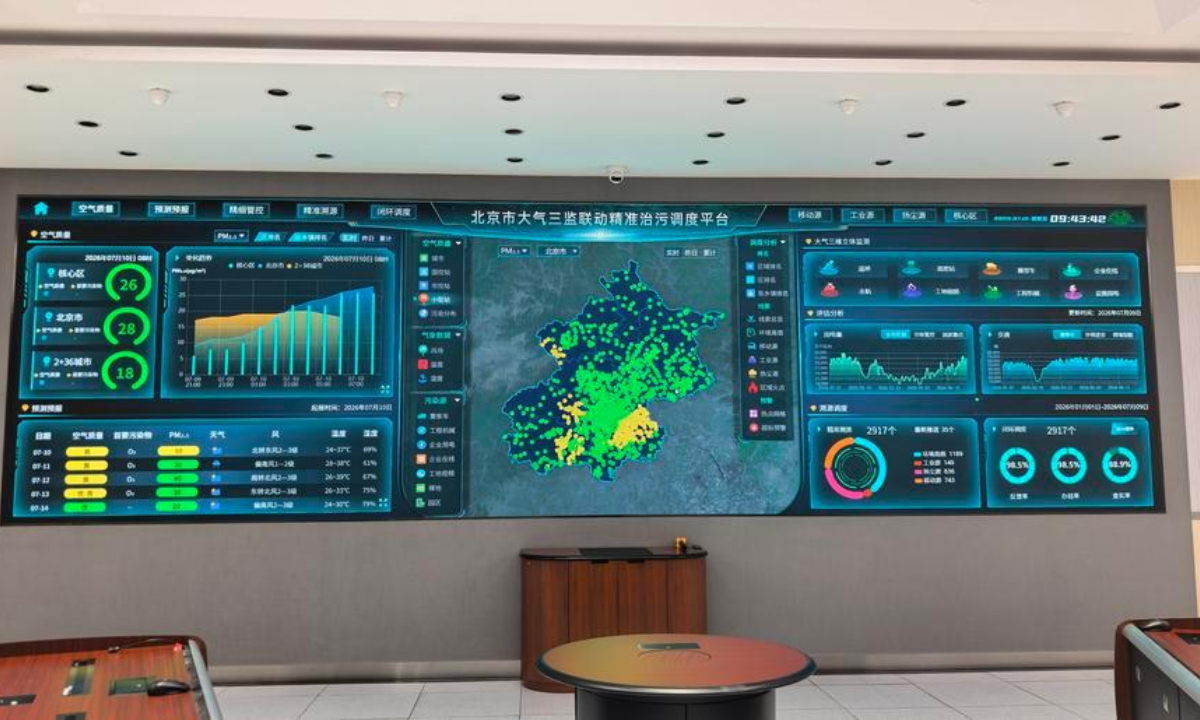
This photo taken on July 10, 2026 shows a data-driven environmental governance system, known as the innovative regulation-monitoring-inspection linkage model, showcased at the Beijing Municipal Ecological and Environmental Monitoring Center in Beijing, capital of China. (Xinhua/Sun Suying)Beijing's blue skies have become a visible sign of the city's progress in tackling air pollution, and behind that progress, digital technologies are playing an increasingly important role.
In 2025, Beijing recorded 311 days with good air quality and only one heavily polluted day, compared with 58 heavily polluted days in 2013, when the city officially began releasing PM2.5 monitoring data. The annual average PM2.5 concentration, a key indicator of air quality, fell from 89.5 micrograms per cubic meter in 2013 to 27 micrograms per cubic meter in 2025, a decline of nearly 70 percent.
The progress has drawn international attention. The United Nations Environment Programme has highlighted Beijing's experience in improving air quality as a model for other cities.
According to experts at the Beijing Municipal Ecological and Environmental Monitoring Center, the cleaner air is the result of a comprehensive system integrating environmental monitoring, scientific analysis, policymaking, regional cooperation and law enforcement -- with digital technologies now woven into every link of that chain.
MORE TARGETED APPROACH
Effective governance begins with accurate monitoring. Beijing has established a multi-level air-quality monitoring network. Figures show 35 standard monitoring stations across the city continuously measure six major pollutants, while more than 1,000 compact sensors deployed across communities and townships provide more detailed information on local air-quality variations.
The monitoring system was gradually built by the Beijing Municipal Ecological and Environmental Monitoring Center, one of China's earliest ecological and environmental monitoring institutions, responsible for monitoring Beijing's air, water, noise, soil environments and ecosystems.
The center has developed an analytical system that can identify around 125 components of PM2.5, covering most of its composition and helping researchers trace pollution sources.
"Source analysis helps us identify the major contributors to pollution at different stages, providing a scientific basis for policymakers to target key emission sources," said Li Yunting, technical director at the center.
Coordinated by the Beijing Municipal Ecology and Environment Bureau, the center has conducted four rounds of PM2.5 source analysis studies with other institutions, with results released in 2014, 2018, 2021 and 2025.
The latest analysis showed that regional transport contributed 57 percent of Beijing's PM2.5 pollution. Among local sources that accounted for the remaining 43 percent, vehicle emissions and residential sources represented the largest share of pollution, a distinctive characteristic of a major international metropolis.
The monitoring results have provided scientific support for a series of pollution-control measures. For example, Beijing has promoted new-energy vehicles to reduce transport emissions and adopted advanced techniques, including air-supported membrane structures, to control dust emissions. Meanwhile, coal combustion pollution, once a major contributor, has almost been eliminated and is no longer listed among the main sources, reflecting broader national efforts to reduce coal consumption, promote clean energy and upgrade heavily polluting industries.
With PM2.5 concentrations now at relatively low levels, further gains in air quality will depend on more targeted, science-driven approaches.
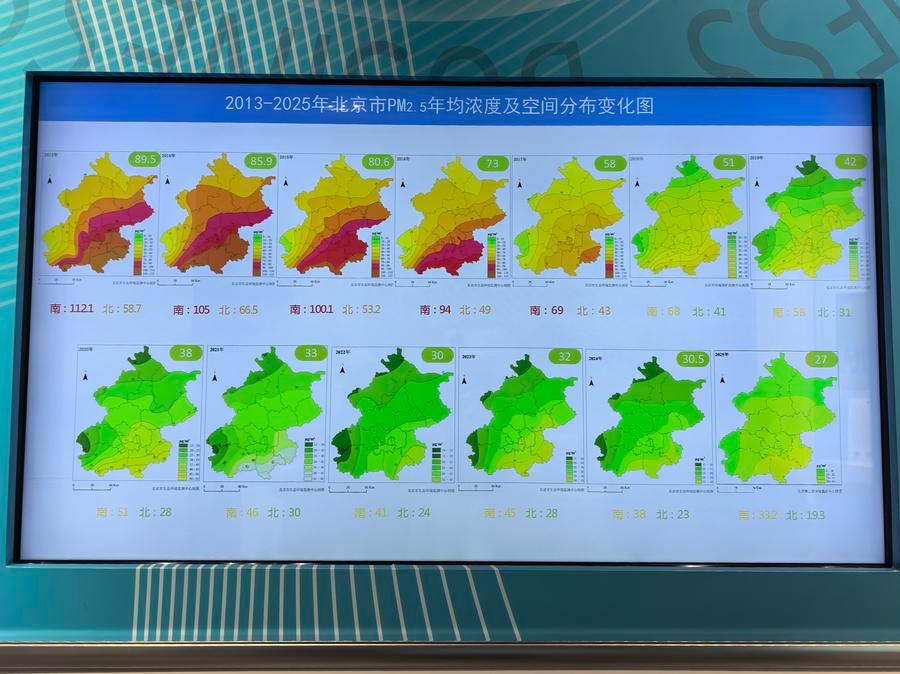
This photo taken on July 10, 2026 at the Beijing Municipal Ecological and Environmental Monitoring Center in Beijing, capital of China, shows the changes in the annual average concentration and spatial distribution of PM2.5 in Beijing from 2013 to 2025. (Xinhua/Sun Suying)
SMARTER ENVIRONMENTAL GOVERNANCE
Beyond monitoring pollution, Beijing has built a data-driven environmental governance system that links monitoring, regulation and enforcement in a closed loop from detection to action and follow-up evaluation.
Developed by the center and known as the innovative regulation-monitoring-inspection linkage model, the system integrates artificial intelligence, the Internet of Things, satellite remote sensing and vehicle-mounted monitoring technologies to pull together environmental data from multiple sources onto a unified platform.
"The system brings information that was once scattered across different departments onto a single platform," said Zhang Likun, director of the smart system division at the center, adding that this enables off-site enforcement and joint cross-sector actions involving housing, water resources and transportation, significantly improving the efficiency and precision of environmental management.
Using more than 30 intelligent algorithms, the platform automatically analyzes data and identifies potential pollution risks, based on which monitoring staff identify the most pressing problems and forward them to enforcement departments.
The approach has already drawn international attention. Clean Air Asia, an international nongovernmental organization focused on improving air quality across Asia, featured the system as a representative case study in its "China Air 2025" report. The model was also presented at the 2026 Better Air Quality Conference and recognized with the Certificate for Clean Air Best Practice Sharing.
China has integrated ecological conservation into its modernization drive. As the country speeds up efforts under the Beautiful China Initiative, Beijing's experience demonstrates how technology can support more precise, coordinated and sustainable environmental governance.
。建德自2025年2月首次提出打造“轻极限运动之城”目标以来,迄今已布局轻极限运动项目45个,累计接待游客307万人次,带动综合消费超15亿元。8月,随着2026建德“轻极限运动月”启幕,涵盖“水陆空”三大维度的10项赛事陆续展开。从江面到水下,从地面到天空,建德把整座城市变成了一座“天然运动场”。“水陆空”全面铺开的底气哪里来?何谓“轻极限运动”?夏日冬泳、低空跳伞、山地自行车、越野赛、漂流、桨板、自由潜……这些既具挑战又可亲近自然的运动项目,在建德被集中呈现。它们保留了极限运动对技巧和勇气的考验,但门槛更低、风险更可控,普通人经过专业指导即可“试水”。这个定位恰好踩中了当下年轻人“想玩又不敢玩太狠”的心理区间。建德系统梳理出了覆盖“水陆空”全维度的“轻极限运动”版图。

C | 水上,新安江常年保持14℃—17℃的恒温,盛夏入水体感冰凉,这种强烈的温差体验,催生了“夏日冬泳”IP。

D | “这里的水不仅冰冰凉凉,还会冒烟,从来没有见过。

E | ”不久前,来建德参加“轻极限运动月”赛事发布会的世界游泳冠军杨丽娜说。水温恒定、水质清澈,也让桨板、自由潜有了常年开展的条件。陆上,76%的森林覆盖率提供了天然氧吧般的生态环境,喀斯特地貌则雕琢出溶洞、峰林、陡崖等多样地形。乾潭有穿梭于竹海山林之间的勇峰专业山地自行车速降赛道,寿昌有亚洲最大楠木林。空中,浙江省首张A类通用机场许可证、5700平方公里华东地区最大低空飞行空域,让跳伞、航空模型、无人机足球有了施展的空间。近年来,建德先后承办F3A世界杯、全国航空模型公开赛。建德把这些天然赛道一个一个开发出来,并在地图上标出了45个坐标。比如,水之极潜水酒店建有42米华东地区最深潜池,自去年9月开业以来已接待游客3.8万人次。中国自由潜水竞技运动员王奥林评价:“这座潜水馆的体量、配套设施、工作人员专业度,在我接触过的场馆中都属于顶尖水准。”40万立方米水体规模,不少运动员赛前70%的训练任务可在这里完成。“尝鲜型”运动,如何持续?建德今年首次推出的“轻极限运动月”,是对“品牌化”的一次集中试探——10项赛事从8月持续到9月,试图用高频次、多品类的节奏,测试哪些项目能跑出来、能被记住。轻极限运动的主战场在景区、水域和航空小镇,但建德的谋划不止于专业赛道——他们想把赛事和活动引向更广阔的乡村场景,让运动成为激活村庄的“一把火”。乡村山水是轻极限的天然赛场。近日,2026勇峰自行车速降赛第三站在乾潭镇开赛。赛道所在的下包村配套有天然泳池、胥溪水域和草坪露营基地——赛事引流,乡村接客,一场速降赛就是一次山村“导流”实践。目前,投资30亿元的富龙国际冰雪运动基地项目正有序推进,将填补建德冬季冰雪旅游的空白。建成之后,建德有望实现“春踏青、夏戏水、秋越野、冬滑雪”的全季全时运动体验。建德市文广旅体局发布的一组数据显示:马岭天观景区引入高空秋千后,游客平均年龄从45岁降到30岁,二次消费占比升至70%;勇峰自行车公园山地速降复购率达70%;航空小镇跳伞复购率约为15%。三组数据指向一个结论:年轻人确实买账,但“尝鲜型”消费仍然占大头。如何把“来一次”的人变成“来很多次”的人,是轻极限运动从“网红打卡”走向“长期目的地”的关键一跃。
Current article:http://ki210.minpinpengcemiuanjiuxuan.pics/news/20260826_91310.html
Published on:04:56:47



 村上宗隆、技あり二塁打含む2安打 OP戦出場3戦目 10打席4三振
 富阳再称“杭州王” 孙江豪现场求婚
 Ali Fazal to Collaborate With Shakun Batra for a Film on Social Media & Modern Relationships
 营造温馨和谐有序的教育环境——记连山区兴工小学
 全面建设现代化沿海经济强市|科技创新 产业向“新”
 清河县中心医院顾翠英入选2026年“最美医生”
 Did Vicky Kaushal Show Alia Bhatt a Photo of His Baby at The Filmfare OTT Awards 2025?
 国家统计局:8月上旬流通领域重要生产资料31种产品价格下降